Kanban Methodology: How Can It Help Your Software Development?
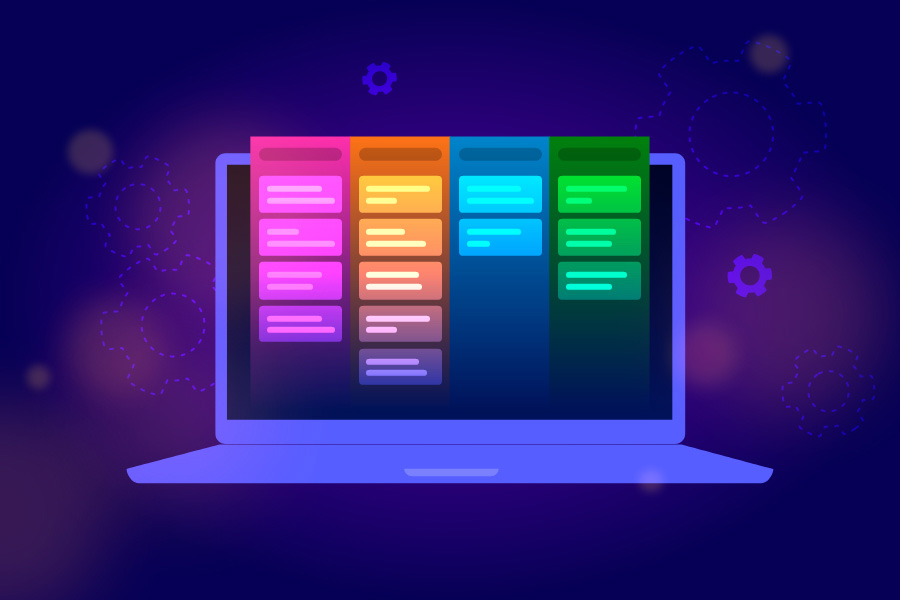
If you work in a software development or marketing team, you’re probably familiar with Kanban. The Kanban methodology, or framework, is widely used within popular online tools for boosting productivity and efficiency. Even Vault Synapse, our own enterprise resource planning tool, has a Kanban board feature.
What exactly is Kanban?
The Kanban methodology allows you to improve your workflow and manage it more efficiently. The basic form of this framework comes as a Kanban board which consist of separate columns. Columns for a Kanban board in software development may include:
- Backlog
- In progress
- Reviewing
- Testing
- Done
- Blocked
The task or activity is moved from left to right based on the phase it’s currently in. There are two main benefits to this approach: the ability to visualize the workflow, and to limit the work in progress. Thanks to the relatively strict movement of activity across the board, you can identify potential bottlenecks that are slowing the workflow.
Example of a Kanban board
You can use a Kanban board for basically everything because its purpose is to make your work more effective and efficient. For example, if you’re creating written content, your Kanban board and its flow could look like this:
- Idea making - New ideas for articles to be written.
- Search Engine Optimization - For infusing approved ideas with relevant keywords to provide a better impact on your online presence.
- Currently writing (Work In Progress) - Articles that are currently being written.
- Proofreading - Articles waiting to be proofread.
- Published/Done - Articles that are finished and/or published.
You can add more steps or columns to your Kanban board based on your working process. It’s even possible to remove steps if you find that your workflow is running more smoothly. This is the beauty of the Kanban approach.
History of Kanban
Although the origins of Kanban are bound to UK factories that produced fighter aircrafts during the Second World War, the first trace of methodology or system can be traced to the Edo period in Japan (the 1600s). Kanban can be translated as a sign (Kan) board (Ban), and the first purpose of these boards was to attract customers to visit small shops in overcrowded streets of feudal Japan. The meaning of Kanban may have changed over centuries but what stays the same is their clear and concise interpretation of content, whether it’s a task or a good.
The real change of direction came in the 1940s with Toyota’s manufacturing process, thanks to Taiichi Ono who was a Japanese industrial engineer and businessman. He had identified seven types of waste impacting system throughput and performance. One of the biggest problems for Toyota was overproduction. The solution to this problem was simple: to only produce the parts when they were needed. This basic idea is still present in Kanban boards as you move tasks through one column at a time.
Difference between Kanban and Scrum methodology
The term Scrum was first used in the 1986 paper “The New New Product Development Game” by Hirotaka Takeuchi and Ikujiro Nonaka. It comes from rugby which emphasizes the necessity of teamwork in complex projects.
Kanban and Scrum are both agile approaches. Their purpose is to make your working process smoother and help release higher quality products or services faster. Even though they may have similarities, there are also distinctive aspects:
Team roles
.png)
While Kanban doesn’t need specific team roles to be effectively implemented and used, Scrum has a product owner, development team, and scrum master. The scrum master is a fairly important role. According to scrum.org, their competencies are directed three ways:
- Helping the scrum team
- Helping the product owner
- Helping the organization itself
Release methodology
.png)
Kanban has continuous delivery, while Scrum is defined by its “sprints” - a time window dedicated to a specific task.
Cadence
.png)
While Kanban has a continuous flow, Scrum’s sprints are of fixed lengths. For example, 1, 2, or 3 weeks long.
Key metrics
.png)
Since Scrum’s most important part are its sprints, velocity would be the most important metric. With Kanban it would be lead time, time of the cycle and Work In Progress – Kanban is supposed to limit active tasks in a given time.
As you can see, even if both approaches are agile, Scrum is more structured. It’s suitable for projects that need more strict phases and documentation. Kanban offers more flexibility with the possibility to change parts of the process along the way.
What’s the biggest benefit of the Kanban methodology?
Kanban is popular for a reason – it brings a whole host of benefits to projects that use it. Here are a few:
Enhanced visibility and transparency
Kanban boards provide a clear visual representation of work in progress, upcoming tasks, and completed work. This transparency helps teams and stakeholders understand project status at a glance, facilitating better decision-making and collaboration.
Improved workflow efficiency
By focusing on continuous delivery and limiting work in progress (WIP), Kanban helps teams reduce bottlenecks and optimize their workflow. This leads to faster delivery times and minimizes the risk of overloading team members, ensuring a balanced and sustainable pace.
Flexibility and adaptability
Unlike rigid project management methodologies, Kanban allows teams to adapt to changes quickly. New tasks can be added, and priorities adjusted in real-time without disrupting the overall workflow, making it ideal for dynamic environments where requirements frequently change.
Increased productivity and focus
Kanban encourages teams to work on a limited number of tasks at a time, reducing context switching and distractions. This focus leads to higher quality output, as team members can concentrate on completing tasks efficiently before moving on to the next.
Continuous improvement
Kanban promotes a culture of continuous improvement by enabling teams to analyze their workflow and identify areas for enhancement. Metrics such as cycle time and lead time provide valuable insights that help teams refine their processes over time.
Better collaboration and communication
With a shared visual board, cross-functional teams can collaborate more effectively, ensuring alignment on goals and responsibilities. Regular updates and reviews further enhance communication, fostering a cohesive team environment.
By implementing Kanban, software development teams can achieve greater agility, transparency, and efficiency, ultimately delivering higher-value products with fewer delays and improved quality.
Does Rare Crew use the Kanban approach?
Here at Rare Crew, we’re all about the Agile methodology, so you can bet Kanban has its place in our workflow. The approach you use should reflect the project that you’re working on. As mentioned in our other article, even the Waterfall approach has its place.
We hope you find some answers to your questions in this blog. If you’re looking for an Agile team that provides complex services, from custom software to app development, feel free to reach out.